

Beyond the Tropopause and Down the Well
Protecting Your Microelectronics for -55°C to 200°C
Heather Srigley, Head of Marketing
May 11, 2026
When engineering mission-critical microelectronics for extreme temperature environments, there is no margin for error. Whether an autonomous Collaborative Combat Aircraft (CCA) is flying a high-altitude profile over the Arctic, or a measurement-while-drilling (MWD) tool is descending into a high-pressure geothermal well, the equipment and microcontrollers inside are subjected to the most brutal physical realities on the planet.
When lives and critical infrastructure are on the line, standard commercial-off-the-shelf (COTS) silicon simply isn't enough. Most commercial CMOS (Complementary Metal-Oxide-Semiconductor) devices—the standard chips found in almost all everyday electronics—are only rated to survive down to -40°C and cap out at 125°C. Push them beyond those limits into extreme temperature or high-radiation environments, and they don't just degrade—they freeze completely or suffer catastrophic, physical-layer failures.
That is why VORAGO uses our patented HARDSIL® technology to fundamentally harden microcontrollers at the silicon level, immunizing them against hardware meltdowns like latch-up and severe cold-weather timing faults. This physical protection is what allows our extreme-temperature VA41600 to operate flawlessly from a -55°C deep freeze all the way up to 200°C.
And as of April 2026, it has set a massive new endurance milestone: recent thermal tests prove the VA41600 sustains uncompromised performance now at 200°C for a staggering 1,000 continuous operating hours.
To understand how we achieved that kind of temperature resistance and longevity, you have to look at the raw physics. Here is the science behind why commercial microelectronics fail in intense cold and blistering heat—and exactly how HARDSIL® is engineered to survive it.
The Deep Freeze: Flying the Arctic Stratosphere
When we think of high-altitude flights, we rely on standard atmospheric models. But the atmosphere fundamentally changes near the poles. At the equator, the stratosphere begins at about 65,000 feet. At the poles, however, the intense cold compresses the atmosphere, causing the boundary layer—the tropopause—to drop to roughly 23,000 feet. If your CCA is cruising at 50,000 feet, it is flying deep inside the Arctic stratosphere.
During the Polar Night of deep winter, the sun doesn't rise. Without solar UV radiation for the ozone to absorb, the stratosphere bleeds heat into the vacuum of space, routinely plummeting below -78°C (-108°F). In these extremes, standard plastics become highly brittle, and commercial electronics suffer severe timing faults or freeze completely.
The Melting Point: Why Heat Kills Commercial Silicon
On the opposite end of the spectrum is the blistering heat of downhole drilling for oil and advanced aerospace engine controls, where ambient temperatures regularly reach 200°C.
All standard bulk CMOS devices are naturally subject to a destructive hardware failure known as latch-up.
What is CMOS? In technical terms, it’s the predominant manufacturing process used to construct modern integrated circuits, including microcontrollers, memory chips, and processors. It uses symmetrical pairs of p-type and n-type transistors to perform logic functions, which allows for high density and low static power consumption.
In plain English: CMOS is the standard recipe used to build almost all modern computer chips. While it is incredibly efficient for everyday electronics like laptops and cell phones, standard CMOS isn't naturally built to withstand the extreme radiation or blistering heat of aerospace and downhole environments without specialized physical hardening.
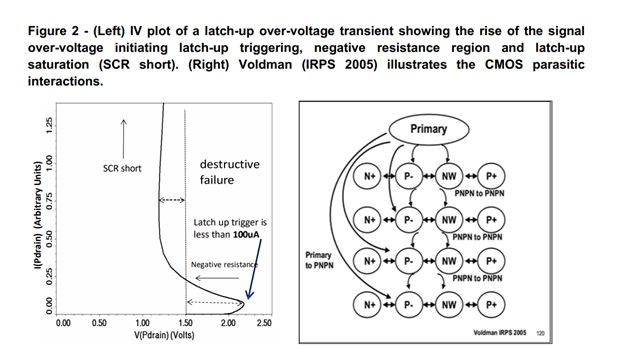
What is latch-up? In technical terms, latch-up occurs when parasitic bi-polar junction transistors (BJTs) inherent in the silicon wafer are accidentally triggered. Once triggered, they form a positive feedback loop that creates a direct short circuit from the power source to the ground (VDD to VSS), destroying the chip.
In plain English: Think of these "parasitic BJTs" as accidental, microscopic phantom switches created during the manufacturing process. Under normal conditions, they stay off. But if a surge of energy flips one of them on, it creates a runaway chain reaction that short-circuits the entire chip.
Why does temperature make this worse? As temperatures rise, the chip's internal resistance to electrical leaks drops. Heat physically reduces the "forward bias voltage" of the p-n diode.
In plain English: The heat effectively lowers the safety barrier. It makes it significantly easier for a random event—like a radiation particle strike or current noise—to flip those phantom switches into an "on" state. As the safety barrier drops, the amount of stray current required to trigger a destructive latch-up drops right along with it.
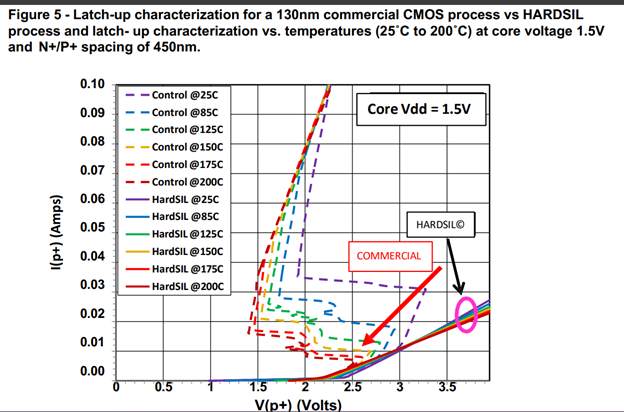
In fact, by the time a commercial core device hits 150°C, its internal holding voltage drops dangerously close to its normal 1.5V operating voltage. This places the device at massive risk of a destructive latch-up event if even a minor noise stimulus occurs.
Above Chart 2: Electron Microscope Cross-Section of HARDSIL® BGR. This cross-section of a VORAGO Technologies microcontroller shows the HARDSIL® Buried Guard Ring implant. The highly conductive layer visible beneath the CMOS structures prevents the parasitic structures from turning on by reducing substrate resistance, acting as the mechanism that eliminates latch-up.
Extra Lightweight Armor to Fortify Your Mission
By implementing the HARDSIL® Buried Guard Ring while manufacturing VORAGO’s microcontrollers in world-class fabrication facilities—such as GlobalFoundries and SkyWater—diode leakage at elevated temperatures is radically reduced. Our test structures exhibit more than 20x less leakage than a standard commercial CMOS structure.
This is why VORAGO microcontrollers can deliver flawless, uncompromised performance across demanding environments—pushing the boundaries of exploration by powering critical equipment into the blistering heat and freezing thermal extremes where humans simply cannot go.
While our VA10805 microcontrollers, built on the Arm® Cortex®-M0 core, utilize HARDSIL® technology to provide incredibly robust radiation resilience in energy and industrial applications (including subsurface drilling facing radiation and heat up to the 125°C operating range), the extreme-temperature VA41600 pushes the envelope even further: surviving the 200°C crushing heat of a geothermal well for a verified 1,000 continuous operating hours as of April 2026.
When you are pushing the edge of the envelope of scientific discovery or military defense—whether through autonomous aerial and ground vehicles, or critical industrial equipment—your extreme-temperature chips need to be as relentless as the environments they operate in. Don't let thermal extremes dictate your mission limits.
Request the Product Datasheet to see how VORAGO’s extreme-temperature, HARDSIL-fortified VA41600 MCU sustains continuous operation through ionizing radiation and extreme temperature profiles. Ask our team the newest high temperature findings: info@voragotech.com
References & Further Reading: This article is based on recent VA41600 thermal testing, foundation technical data and testing profiles detailed in VORAGO Technologies' official whitepapers.
For a deeper dive into the physics and test results, you can read the full papers here:
Using HARDSIL® to Minimize the Impact of Extreme Temperature on CMOS Integrated Circuits
Easy Radiation-Hardening of Conventional Integrated Circuits Using HARDSIL® Technology
Above Chart 1: Latch-Up Trigger Current (Commercial vs. HARDSIL®). This graph plots the trigger current data for a 130nm commercial process (dashed lines) against a HARDSIL® process (solid lines) across a temperature range of 25°C to 200°C. Notice how the commercial device's trigger current drops aggressively as temperature increases, leading to a destructive short circuit. In stark contrast, the HARDSIL® test device does not trigger into latch-up across the testing range, remaining completely immune up to 200°C.
The Physical Solution: How HARDSIL® Works
You cannot patch a physical-layer hardware meltdown with a software update. To survive 200°C heat, or even 125°C heat combined with deep space radiation, the silicon substrate itself must be fundamentally altered.
Vorago solves this through our innovative, patented HARDSIL® process technology, which implements a Buried Guard Ring (BGR) directly beneath the standard CMOS structures.
What’s a Buried Guard Ring? In engineering terms, the BGR acts as a highly conductive low-resistance shunt within the P-type silicon, significantly improving the grounding plane. This pins the foundation voltage (the Pwell potential) at 0 V.
In plain English: The BGR acts as an electrical safety net built right into the foundation of the chip. It creates an ultra-easy path for stray electricity to exit the circuit harmlessly. Because it locks the foundation's voltage at zero, it physically starves those accidental "phantom switches" of the forward bias they need to turn on.
SUBSCRIBE TO OUR NEWSLETTER FOR THE LATEST UPDATES ON VORAGO PRODUCTS AND SERVICES.