
From Space to Sea: Risk Differences Between Harsh Environments
Understanding Radiation, Thermal, and Operational Risk Differences Between Harsh Environments
Heather Srigley, Head of Marketing, VORAGO Technologies
August17, 2026
In modern aerospace, defense, and orbital computing, there is no longer a single radiation protection standard for harsh environments. Designing an electronics system for deep space requires entirely different silicon risk tolerance and physical architecture than for commercial Low Earth Orbit (LEO) satellite constellations, autonomous defense vehicles, or oil and gas exploration beneath Earth’s surface. They all come with different radiation realities and extreme temperatures both hot and cold.
Historically, engineering teams faced a binary choice: pay a massive cost and size premium for over-designed military-grade space chips or accept the extreme liability of under protected commercial chips.
Today, over specifying hardware and semiconductor components drives up size, weight, power, and cost (SWaP-C), while under protecting those components can lead to catastrophic mission failure. The future belongs to a new paradigm: mission-matched microelectronics protection—delivering the exact level of radiation resilience required by the physics of the environment, optimized for the economics of the business.
To achieve this balance, let’s first map the real physical risks across the four primary operational domains.
1. Space Discovery & Multi-Decade Survival
Medium, Geostationary, and Beyond Earth Orbits
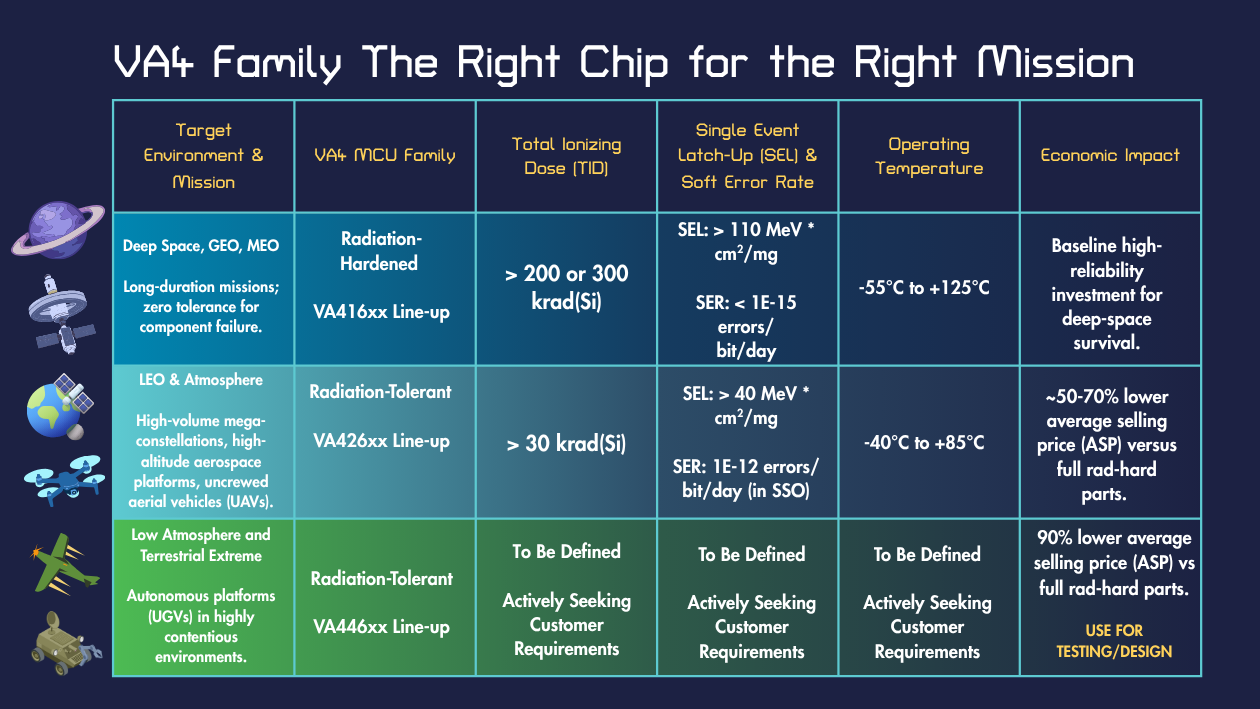
Trapped Belts & Solar Corridors: In the highest of Earth’s orbit and deep space, hardware replacement is impossible. Systems operate under a relentless exposure risk inside high-energy trapped particle belts and severe solar corridors. Even behind standard spacecraft shielding—typically a baseline of 100 mils of aluminum, or about the thickness of two stacked dimes—components face a brutal Total Ionizing Dose (TID). This accumulation reaches 10 to 25 krad(Si) TID annually in Geostationary Earth Orbit (GEO), soaring to over 100 krad(Si) TID annually within the heart of Medium Earth Orbit’s (MEO) harshest environments.
Single-Event Effects (SEE) Vulnerabilities: Without Earth’s natural magnetic shielding, flight systems encounter a constant operational risk from the heavy bombardment of heavy ions – high-energy atomic fragments originating from deep-space supernovas and intense solar flares. For standard or under protected electronics, this introduces severe background data corruption with Soft Error Rates of 1E-4 errors per bit/day. While engineering workarounds like component up-screening or bulky Radiation-Hardened-By-Design (RHBD) architectures attempt to patch these flaws, they inherently inflate system SWaP-C—all while leaving those chips exposed to continuous vulnerability of catastrophic, permanent hardware lockups known as Single Event Latch-ups (SEL).
Thermal Extremes: The deep-space void also presents a severe thermal survival risk. Without an atmosphere to naturally regulate temperatures, systems must endure rapid, raw swings ranging from the cryogenic cold of prolonged planetary shadows (approximately -150°C) to intense solar baking (approximately +150°C). These temperature swings make the environmental endurance of a microcontroller (MCU) or microprocessor (MPU) a critical project liability.
2. Global Constellations & Tactical Defense
Low Earth Orbit and High-Altitude Flight
The Optimization Challenge: Satellites in LEO are faced with an entirely different risk profile. Earth’s protective magnetosphere buffers satellites, shielding internal electronics down to a manageable 1 to 5 krad(Si) TID per year behind that same dime-thick aluminum shell. This typically totals TID of <30 krad(Si) over a standard commercial constellation's 3-5-year lifecycle.
Fleet-Wide Disruption: While cumulative radiation builds slowly within Earth’s low orbit and high-altitude atmosphere, the primary threats become sudden, single-event disruptions particular in software – known as “bit-flips.” As an example, spacecraft must routinely brave the South Atlantic Anomaly (SAA), which floods electronics with intense high-energy proton streams which are measured by Soft Error Rates (SER) of 1E-4 Errors per bit/day. For massive commercial satellite fleets relying on under protected semiconductor components, this exposure introduces a high probability of frequent memory bit-flips and destructive hardware latch-ups, risking systemic fleet downtime.3
Cyclic Thermal Stress: Internal spacecraft environments in LEO carry an aggressive thermal fatigue risk as well. Because satellites rapidly transition between eclipse shadows and direct solar baking about every 1.5 hours, MCUs and MPUs face continuous expansion and contraction stresses, threatening long-term physical reliability.
3. Ground Operations & Autonomous Defense Systems
Low Atmosphere and Terrestrial Extremes
Moving closer to earth, uncrewed aerial and autonomous ground vehicles (UAVs/UGVs) and tactical defense equipment face unique planetary vulnerabilities:
Atmospheric Shielding: Protected by a thick atmospheric blanket, sea-level systems do not experience space-bound heavy ions. However, crewed and uncrewed ground fleets face high-energy neutrons and alpha particles coming from the sun.4
Data Integrity Liabilities: While terrestrial particles rarely cause the physical structural damage to silicon that requires the cumulative TID radiation hardening outlined in space agency frameworks like MIL-STD-883, Test Method 1019, they do maintain a constant risk of random memory bit-flips that corrupt data execution and compromise processing stability mid-operation without warning.
Compounded Thermal Stress: From Arctic cold to desert heat, ground and subsurface electronics face rapid ambient temperature swings compounded by intense internal self-heating inside sealed, non-ventilated enclosures. As a result, several energy companies use extreme-temperature MCUs to protect downhole equipment. After years of success fortifying Arm® Cortex®-based MCUs against subsurface heat, VORAGO is now developing a more tailored terrestrial MCU for terrestrial UGVs. The company is now seeking customer input and requirements on specific thermal and radiation performance ranges within its new Radiation-Tolerant by Design (RTBD) category. The first proposed microcontrollers, the VA44630 – based on Arm Cortex-M4 cores –would address radiation performance trade-offs between extreme temperatures and lower SEL and SER immunity ranges.
4. Energy Extraction On and Off Earth
Deepwater Subsea and High-Pressure Downhole Realities
Extreme Pressure & Moisture: In subsea operations and marine deployment, hardware retrieval is deeply expensive and operationally complex. Equipment at deep water depths exceeding 3,000 meters must withstand crushing ambient pressures above 4,400 psi (300 bar), alongside the constant threat of highly corrosive saltwater and internal moisture condensation inside sealed enclosures.5
Localized Radiation & Thermal Baking: For deep subsurface energy extraction and geothermal drilling, the risk profile shifts from cosmic rays to extreme, earth-bound localized conditions. VORAGO MCUs must operate and survive within High-Pressure, High-Temperature (HPHT) zones exceeding 150-200°C, combined with intense, localized radiation fields emitted by nuclear logging-while-drilling (LWD) tools used to evaluate geological formations.6
Mechanical Shock & Structural Vibration: Finally, severe physical stress factors into microchips that operate on open marine vessels or deep within an active drill string. VORAGO chips made with HARDSIL® technology, such as the VA10805 MCU, face unrelenting, high-impact mechanical shock and continuous structural vibration from ocean waves, heavy engines, and drill bits fracturing rock. Severe motion can easily shatter solder joints or loosen internal electrical contacts mid-operation.
Conclusion: The Power of Mission-Matched Microcontrollers
Understanding these four distinct harsh environments reveals a clear operational truth: over-specifying a component is just as dangerous to mission economics as under-specifying is to its survival.
Deploying a deep-space chip with massive heavy-ion protection into a terrestrial drone or a subsea vessel means forcing engineering teams to pay for performance margins they’ll never use. Conversely, throwing unrated commercial hardware into a LEO constellation creates unacceptable financial liability from random field failures, never mind the heightened risk of space debris and lost public trust.
The future of high-reliability MCUs and MPUs depends on design flexibility. By choosing mission-matched, optimal radiation and temperature protection at the right price point, companies can close the long-standing gap between expensive space-grade chips and cheaper, yet far riskier unprotected silicon.
True innovation for specialized semiconductor pioneers means aligning the exact physics with the economic reality – whether you’re designing for Earth’s ocean floor, atmosphere, orbits or moon.
Technical Sources:
1 NASA Spacecraft Charging Guidelines
2,3 Vanderbilt University CREME96 Modeling
4 JEDEC JESD89 Soft Error Standards
5ISO Subsea Standard 13628-6 / API 17F
6 NETL Downhole Engineering Baselines