

The End of the Redesign Tax
How Mission-Matched Radiation Protection Rewrites Aerospace Economics
By Jim Carlquist, Senior Field Sales Engineer & Heather Srigley, Head of Marketing
September 25, 2026
For decades, a lose-lose compromise has forced aerospace and defense engineers to make difficult trade-offs when selecting microelectronics for mission-critical spacecraft, satellite constellations, aviation platforms, and extreme terrestrial vehicles. This friction is driven by an invisible, unyielding reality: radiation strikes that multiply exponentially the moment an asset leaves the ground. While background particles are a minor nuisance at sea level, they quickly become debilitating, mission-ending threats to unprotected silicon in high-altitude flight, orbit, and deep space.
Today, this threat is more severe than ever. According to findings from NASA and NOAA, we are navigating the active, intense maximum phase of Solar Cycle 25. This natural 11-year solar cycle, which began in 2019, is expected to run through 2030—the exact same window where global commercial and defense mega-constellations are projected to reach over 60,000 active satellites in orbit, quintupling from over 12,000 today. This creates an unsustainable environmental clash: a peak surge of historic solar flares and intense particle storms is slamming our active aerospace corridors at the exact moment orbital volume is skyrocketing. Because too many mega-constellation payloads rely on upscreened chips and software patches rather than silicon-level radiation hardening, this solar maximum multiplies premature, radiation-induced failures. The resulting influx of dead, drifting hardware creates an immediate hazard, directly feeding the cascading space debris problem.
Historically, navigating these harsh environments has forced engineers into a rigid, binary choice. On one side is traditional deep-space-grade silicon: radiation-hardened-by-process (RHBP) components, known at VORAGO as HARDSIL®. These parts deliver exceptional reliability, but at high cost, long lead times, and performance that often lags the commercial market by a decade or more. On the other side sits Commercial-Off-The-Shelf (COTS) silicon.
Standard commercial chips may be more affordable but using them in mission-critical systems is an existential gamble. A single heavy-ion hit can trigger a Single-Event Upset (SEU) or a catastrophic latch-up—instantly corrupting flight telemetry, blinding navigation sensors, or locking up a command system. In an instant, a multimillion-dollar satellite is rendered permanently dead. Not only is it a crushing economic loss, but it also turns a high-value asset into dangerous space junk drifting blindly through orbit.

To break this bottleneck, especially in low Earth orbit (LEO), lower-altitude aviation or autonomous ground defense, engineering teams often turn to upscreening – testing standard commercial chip lots to isolate and select specific batches that happen to tolerate higher radiation thresholds. While upscreening works well for certain mission tiers, it alters nothing within the foundational silicon architecture.
Without built-in physical hardening at the silicon level, aerospace and satellite companies compensate by paying a steep "Software Tax." They burn thousands of developer hours writing complex software-level Error Detection and Correction (EDAC) and Triple-Modular Redundancy (TMR) loops just to prevent mid-mission failure—bloating code, draining power, and stalling launch timelines. And there is still no guarantee. It happens on military and commercial planes alike, mirroring the high-profile Airbus A320 mid-air radiation upsets and subsequent groundings in late 2025.
With the space economy accelerating and defense theaters demanding autonomous edge computing, a forced binary choice is no longer viable. New space paradigms demand a middle ground: optimized hardware that eliminates both excessive premium costs and unacceptable mission risk.
VORAGO enables this shift by building radiation and thermal protection directly into the silicon, and now delivering a guaranteed performance envelope tailored to every orbit, domain, and extreme environment.
As LEO satellite networks expand at an unprecedented pace, deploying autonomous edge intelligence and critical control systems requires a fundamental shift in mindset. Engineers must look beyond how silicon is made and focus relentlessly on matching mission reliability to the specific orbit or environment within an optimized price-to-performance window. True innovation rejects the high-risk exposure of unhardened commercial silicon in favor of Radiation-Tolerant-by-Design (RTBD) architectures—integrating radiation protection from the outset to deliver trusted mission success without the premium price tag.

With the introduction of the expanded VA4 family of rad-hard and rad-tolerant microcontrollers—built on Arm® Cortex®-M4 cores—VORAGO is aiming for exactly that: an expanded portfolio of eight distinct, compatible MCUs that offer 100% architectural scalability, drastically reducing not only the cost of the radiation-tolerant units but, more importantly, the industry's costliest hidden line item—the Redesign Tax.
VORAGO can now eliminate this costly Redesign Tax with the introduction of 100% compatible twin radiation-hardened and radiation-tolerant microcontrollers (MCUs) across our VA4 and VA5 portfolios, providing mission-matched technology that delivers deep radiation protection in the silicon at the device and design levels—engineered directly into the component and the silicon layer itself for both tiers. Built to withstand extreme temperatures and radiation, these microcontrollers utilize specialized packaging to ensure component-level survivability in harsh space environments. This unique architecture embeds robust, hardware-level Error-Correcting Code (ECC) directly into silicon to automatically detect and correct radiation-induced bit flips and Single Event Upsets (SEUs) in real-time. By resolving data corruption instantly at the chip level, VORAGO completely eliminates the need for complex system-level mitigation, heavy shielding, or external software redundancy.
Focus on Radiation Price/Performance
Historically, procurement and engineering teams have been obsessed over the internal manufacturing details of microelectronics. We endlessly debate the nuances of high-premium Radiation Hardened by Process (RHBP) versus high-risk up-screened COTS, mistakenly treating the manufacturing method as the primary metric of success.
It is time to shift that perspective. What modern space, satellite, and defense missions require isn't a debate over silicon architecture; it is a guaranteed performance envelope.
Late in 2025, VORAGO expanded its lineup with a new Radiation Tolerant by Design (RTBD) category, offering a cost-effective alternative to premium rad-hard chips. Like all VORAGO microcontrollers built on Arm® Cortex® cores, the RTBD approach integrates radiation and temperature mitigation directly into the silicon from the ground up. The difference lies in the optimization: it delivers a right-sized level of protection tailored specifically for Low Earth Orbit (LEO) and lower-altitude space missions, which significantly reduce component costs where these new constellations operate.
Ultimately, customers navigating the toughest environments aren’t purchasing silicon manufacturing techniques; they are purchasing peace of mind and ironclad safety that their systems won’t fail in orbit, mutate into hazardous space debris, or trigger critical system failures in the atmosphere below.
One Design. Any Orbit. Any Mission.
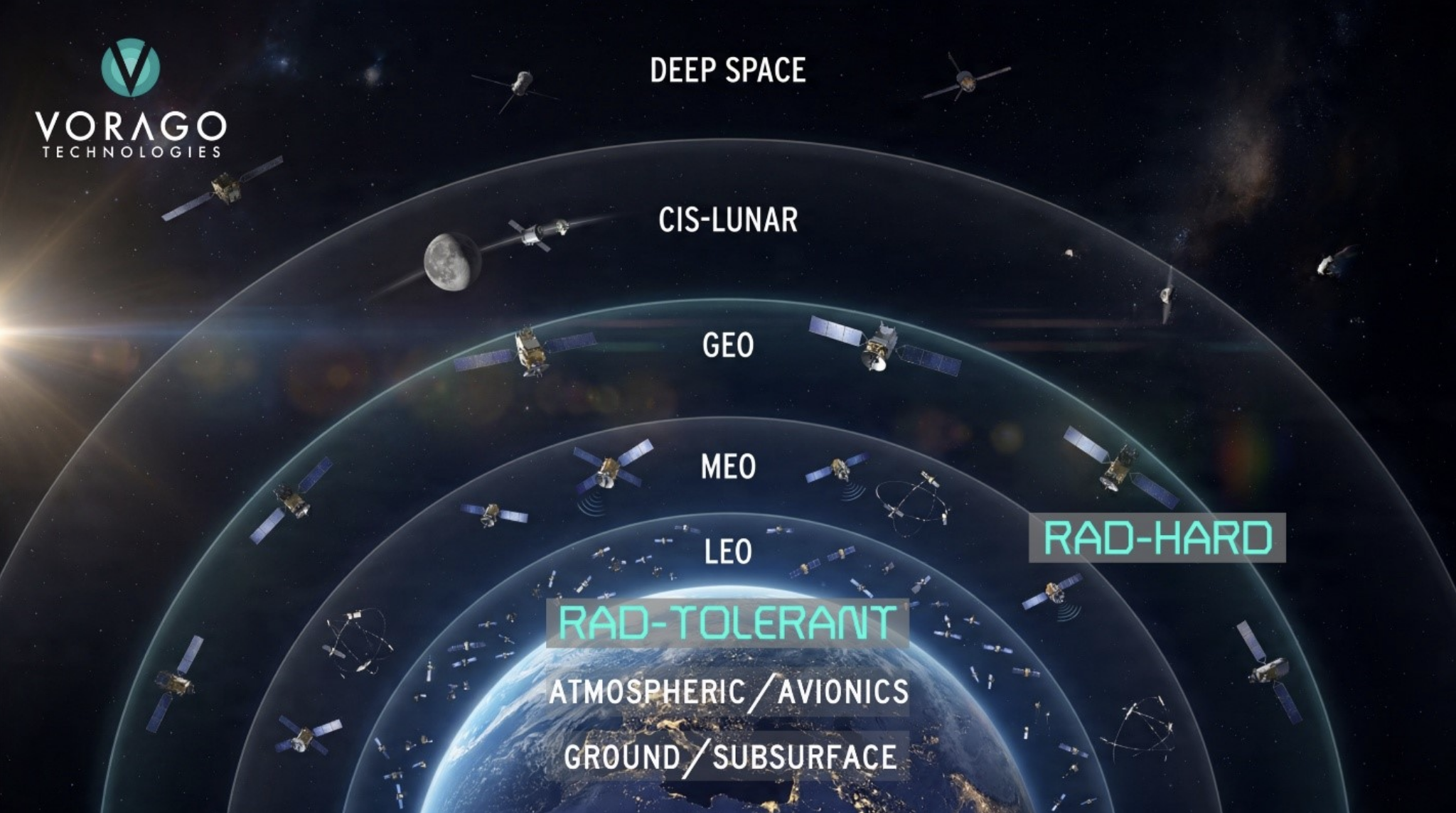
The physical realities of your target environment — LEO, MEO, and GEO, for example — dictate the radiation and thermal performance envelopes your systems require. Rather than forcing engineers to choose between an over-engineered, high-cost chip or a risky, unrated commercial gamble, space electronics performance today must be right-sized. VORAGO is in a unique position to do exactly that with the best RHBP and RTBD options tailored to the ideal price/performance required.
By matching hardware-level protection directly to the operational environment, engineering teams can secure ironclad reliability without blowing past mission budgets. Environmental threats are not monolithic; they range from extreme temperature swings to radiation-induced software errors capable of instantly shutting down microelectronics or corrupting the critical data they control. As illustrated below, deploying the right VORAGO microcontroller ensures targeted, cost-effective survivability across every physical domain.
Protection & Risk Levels Vary – Here’s Why
Maximizing mission success requires an exact alignment between the physical realities of your deployment and the specific protection levels of your components. Because over-specifying hardware wastes valuable budget while under protecting creates catastrophic operational liabilities, mapping out the precise threats of each domain is a critical first step.
Below is a top-line overview of the core environmental threats and liabilities your hardware must survive.
1. Medium, Geostationary, & Deep Space Orbits
Brutal Total Dose (TID): Irreplaceable hardware faces severe cumulative radiation—10 to 25 krad(Si)/year in GEO, skyrocketing to over one hundred krad(Si)/year within MEO’s trapped proton belts (Source: NASA Spacecraft Charging Guidelines)
Heavy-Ion Disruptions: Devoid of Earth’s magnetic buffer, raw deep-space cosmic rays bombard systems. For under protected components, this causes continuous data corruption and the threat of permanent Single Event Latch-ups (SEL). (Source: Vanderbilt University CREME96 Modeling)
Thermal Volatility: Without an atmosphere to regulate heat, microelectronics must endure rapid, unbuffered swings ranging from cryogenic eclipse shadows (~ -150°C) to intense solar baking (~ +150°C).
2. Low Earth Orbit (LEO) & High Altitude
The Optimization Profile: Earth’s magnetosphere buffers the environment, shielding internal electronics down to a manageable 1 to 5 krad(Si)/year behind a standard aluminum shell.
Single-Event Fleet Risks: While cumulative dose builds slowly, single-event disruptions dominate. Routinely passing through the South Atlantic Anomaly (SAA) floods unhardened commercial fleets with high-energy protons, triggering frequent bit-flips and fleet-threatening downtime (Source: Vanderbilt University CREME96 Modeling
Cyclic Thermal Fatigue: Because LEO satellites transition between eclipse shadows and direct solar baking every 90 minutes, microelectronics face aggressive, ongoing physical expansion and contraction stresses.
3. Low Atmosphere & Terrestrial Extremes
Invisible Soft Errors: Terrestrial and atmospheric fleets are protected from deep-space heavy ions but are continually bombarded by high-energy atmospheric neutrons and packaging alpha particles. (Source: JEDEC JESD89 Soft Error Standards).
Data Integrity Liabilities: While these low-atmosphere particles rarely cause permanent physical structural damage (TID), they pose a constant risk of random bit-flips that corrupt live data execution and compromise processing stability mid-operation without warning.
Compounded Thermal Stress: From flight-level atmospheric cold to desert floor heat, autonomous hardware faces rapid ambient temperature swings compounded by intense internal self-heating inside sealed, non-ventilated enclosures.
Partner Opportunity: To protect autonomous defense systems, VORAGO is now developing a tailored, radiation-tolerant VA4 MCU optimized specifically for Earth-bound environments. We are actively seeking customer input on target thermal and radiation performance ranges, as well as the trade-offs between extreme temperature operation and lower SEL and SER immunity thresholds.
For a comprehensive breakdown of the raw physics and specific risk profiles across these domains, read our full companion piece: From Space to Sea: Understanding Radiation, Thermal, and Operational Risk Differences Between Harsh Environments.

The Power of 100% Scalability: Crushing the "Redesign Tax"
Navigating these radically different environmental threats has historically meant designing a completely unique hardware platform for every single mission profile. This fragmented approach introduces a massive financial and operational penalty: the Redesign Tax.
If a defense contractor designed a system for a deep-space lunar payload and later wanted to adapt that exact application for a commercial low-orbit satellite constellation, the engineering team had to start again. Changing the microcontroller meant completely rewriting the codebase, redesigning the PCB layout, altering the power management architecture, and re-running months of expensive qualification testing. This heavy Non-Recurring Engineering (NRE) expense quietly drains aerospace budgets and consistently delays launch windows.
The VA4 family completely rewrites these project economics through 100% cross-portfolio compatibility. By utilizing the same silicon DNA and foundry across its eight compatible microcontrollers, VORAGO allows engineering teams to design just once, and then seamlessly scale it across any orbit or environment.
Whether you deploy a premium Radiation-Hardened-by-Process (RHBP) MCU into deep space or a cost-optimized Radiation-Tolerant-by-Design (RTBD) twin into LEO satellites and autonomous combat aircraft (CCA), the core architecture and technical specifications remain completely identical. What does change is simply the guaranteed radiation performance and the price tag. You get optimal, mission-matched protection at the right price point, while drastically reducing the costly redesign loop and protecting your original NRE investment—accelerating your speed-to-fleet to deploy mission-ready systems years ahead of the competition.
Streamlining the Engineering Lifecycle
In practice, this operational agility fundamentally changes how your engineering team executes, transforming abstract speed into a tangible competitive advantage. Instead of siloing projects by environmental severity, engineers can design the core equipment architecture, finalize the schematic capture, and lock in the identical PCB layout exactly once.
When your deployment requirements shift, the engineering team can simply drop the mission-matched MCU twin onto the existing board. This unified electrical, software and physical footprint drastically reduces engineering duplication, avoids costly ground-up PCB redesigns, and protects invaluable development schedules—allowing you to fully preserve and reuse your initial Non-Recurring Engineering (NRE) investment.
Maximizing Early-Stage Development Economics
This flexibility also introduces a major financial advantage long before launch day. By completely decoupling your equipment's functional capabilities from the final radiation and temperature grade, the VA4 portfolio—built as four distinct sets of 100% compatible twin chips—allows teams to seamlessly substitute devices based on changing mission severities.
Each pair matches a premium Radiation-Hardened-By-Process (RHBP) variant with a cost-effective Radiation-Tolerant-By-Design (RTBD) counterpart. Because these twins remain completely functionally identical and share the exact same internal technical specifications, your team can leverage the RTBD chips as affordable hardware placeholders during early bench prototyping and system validation.
Your engineers can build, assess, and debug their physical layouts on economical prototype boards today, with absolute confidence that the system architecture will execute flawlessly on high-reliability, fully space-qualified flight hardware tomorrow. This approach significantly lowers upfront project capital, de-risks the early development phases, and keeps your budget strictly aligned with your current milestone requirements.
The VA4 Product Matrix: Identical DNA, Mission-Matched Protection
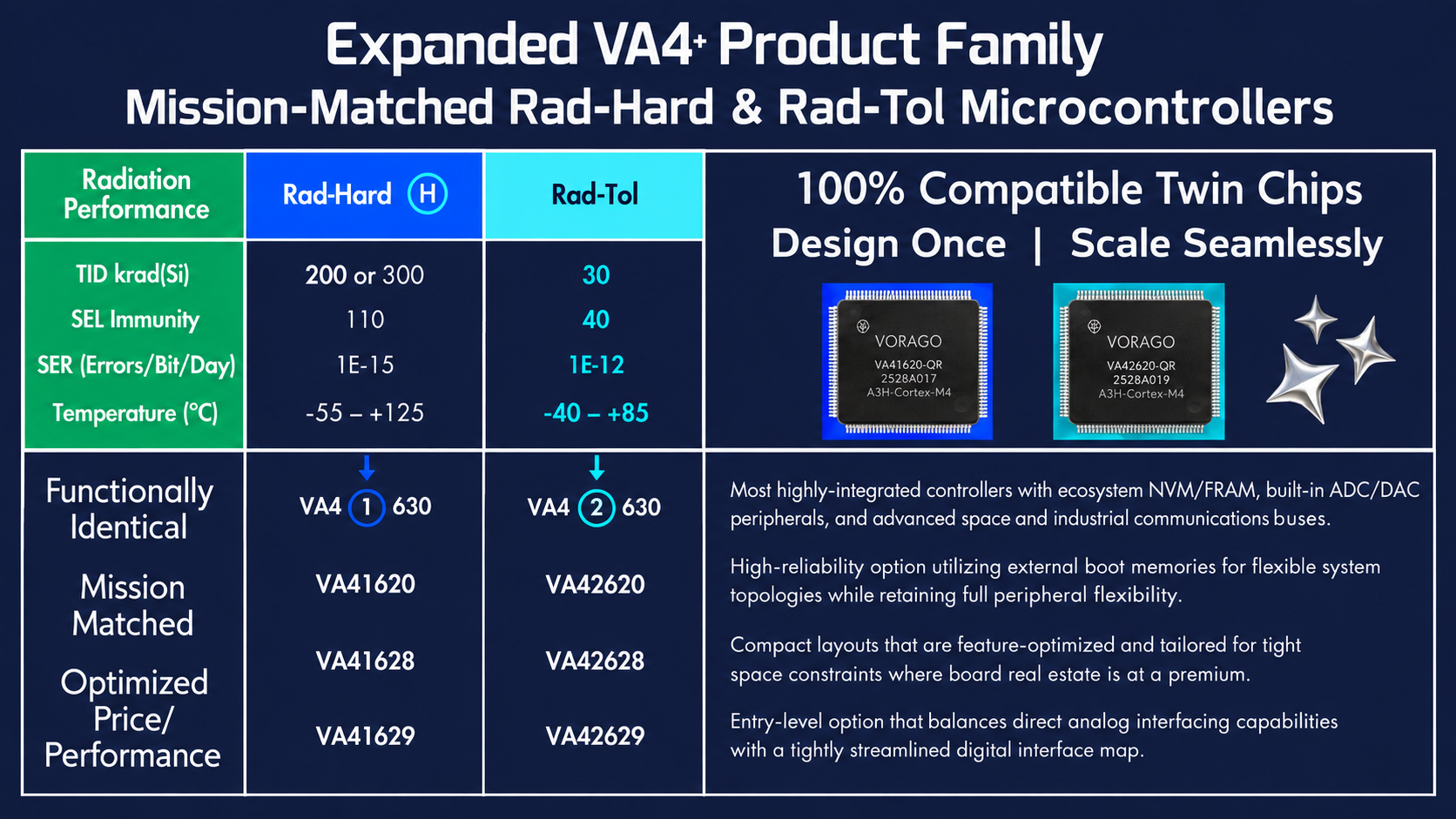
To help you select the exact level of protection your mission requires, without paying for performance margins you do not need, we split the eight microcontrollers of the compatible VA4 family into four targeted pairs, each offering slight variations on the core feature set.
To identify your tier, look at the part number suffix: Radiation-hardened versions feature the letter 'H' (signifying full-strength HARDSIL®) and the number '1' immediately following VA4. Conversely, radiation-tolerant versions use the number '2', as shown below.
Real-World Case: VA41620 & VA42620 Twin Chips
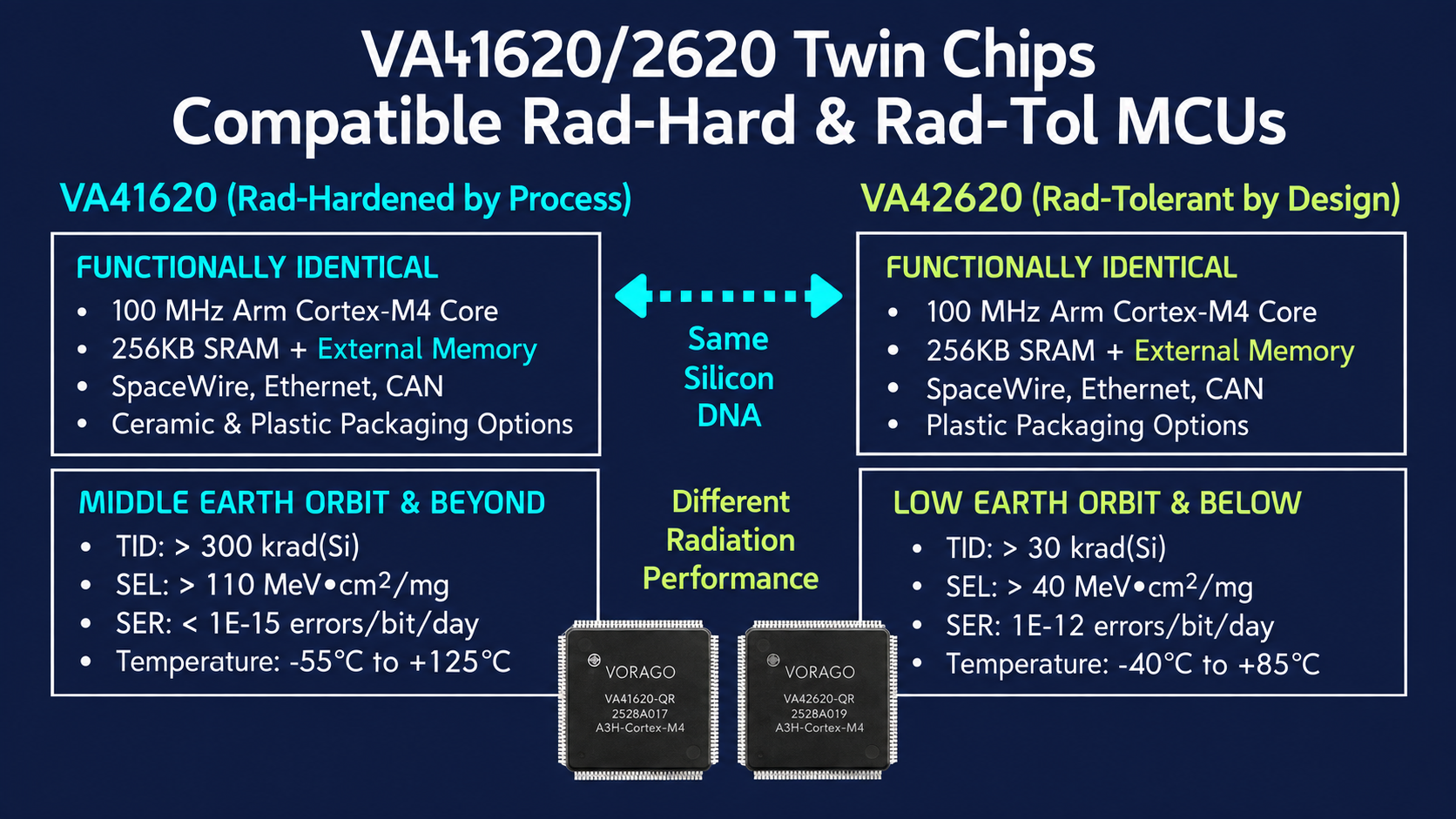
To see how this architecture shifts mission economics, look at the relationship between the radiation-hardened VA41620 and its new radiation-tolerant twin, the VA42620. While these two MCUs target entirely different price-and-performance envelopes, they share an identical functional feature set, pinout footprint, and software codebase.
They differ only where the orbit demands it: guaranteed radiation performance. By right-sizing protection specifically for LEO-level barriers, the radiation-tolerant VA42620 delivers a massive reduction in unit hardware costs compared to its deep-space-grade twin.
This gives aerospace, defense, satellite, and autonomous vehicle architects a flexible, cohesive, and high-reliability set of choices—at a more affordable price. An MCU can function as the central flight computer on a lunar lander or seamlessly scale down to a cost-efficient controller on a low-orbit satellite—such as supervising and executing complex FPGA reconfiguration routines to safeguard adjacent high-speed data processors from radiation-induced latch-ups.
Why the Market Demands Urgency
The timeline for aerospace and defense development is shrinking from decades to years, and years to months. Constellation operators are rushing to secure orbital slots, and defense commands require rapid deployment of autonomous assets to maintain tactical advantages.
In this climate, spending 18–24 months rewriting software, re-routing circuit boards, and re-qualifying core hardware just because an asset shifted to a new orbital or mission tier is an unacceptable risk and frankly, uncompetitive.
The expanded VA4 family changes the competitive landscape. By providing an uninterrupted path from prototyping to deployment across eight identical-footprint options, it allows developers to move faster, protect their engineering investment, and optimize their mission economics from day one. Companion rad-hard and rad-tol microcontrollers speed up launch dates with broader price/performance choices than ever before.
It is time to put expensive upscreening and software patches behind us and embrace the One Design microelectronics methodology with built-in silicon reliability and seamless scalability from LEO to MEO to GEO, and beyond and below.
Design once. Scale infinitely. The era of the Redesign Tax is officially over.